ART Short-Term Systematic Strategy
Relationship to Traditional Markets and Select CTA Benchmarks
Correlation analysis helps evaluate the historical relationship between the ART Short-Term Systematic Strategy and broader market exposures, including traditional asset classes and select CTA benchmarks. The purpose is to assess diversification characteristics, return stream differentiation, and potential portfolio construction relevance within a broader allocator framework.
Purpose of the Analysis
The objective of this study is to evaluate the historical relationship between the ART strategy and a range of external market references, including:
- Global equities
- Fixed income
- Commodities
- Broad hedge fund / managed futures proxies
- Select CTA programs or indices, where applicable
Correlation does not predict future results, but it can provide useful context when assessing how a strategy may complement existing portfolio exposures.
Why Correlation Matters
For allocators, family offices, and Qualified Eligible Persons evaluating alternative strategies, correlation analysis can help answer several practical questions:
- Has the strategy moved in line with traditional risk assets?
- Has it behaved differently from long-only equity and bond exposures?
- Does it provide return stream diversification relative to broader portfolios?
- How closely does it track or differ from other CTA programs?
A lower or unstable correlation profile may indicate that the strategy is drawing returns from different underlying drivers than traditional market beta.
Traditional Market References
• S&P 500
• Nasdaq-100
• U.S. Treasury or Aggregate Bond proxy
• Broad Commodity Index proxy
CTA / Alternative References
• SG CTA Index
• BTOP50 Index
• SocGen Trend Index
• Select CTA manager benchmarks, where appropriate and available
Correlation Matrix (Monthly Returns)
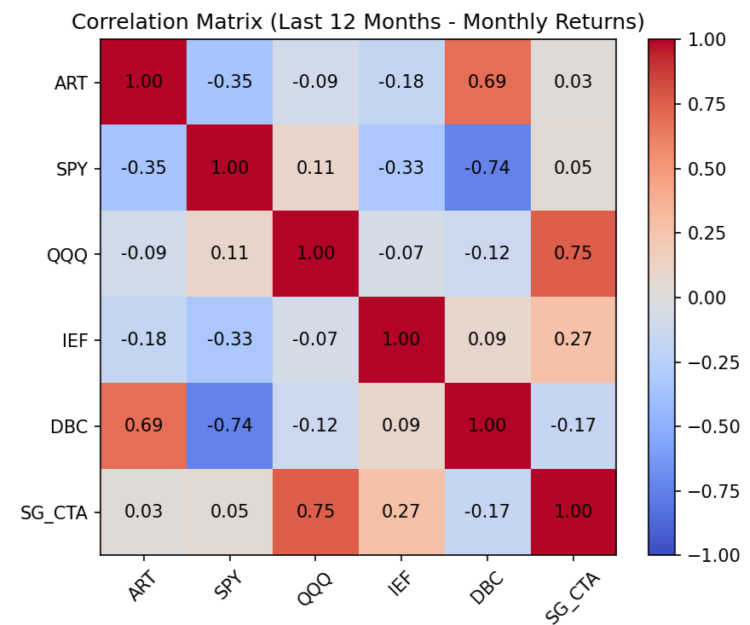
The table below is designed to show the historical relationship of ART returns to traditional market references and selected CTA benchmarks across multiple time horizons.
Correlations are calculated using monthly returns across the stated observation periods.
| Statistical Correlations | ART Short-Term Systematic | SPY | QQQ | IEF | DBC | SG CTA |
|---|---|---|---|---|---|---|
| Last 12 Months | ----- | -0.35 | -0.09 | -0.18 | 0.69 | 0.03 |
| Last 24 Months | ----- | -0.07 | 0.18 | -0.18 | 0.27 | -0.26 |
The ART strategy exhibits low to moderate correlation to traditional asset classes and limited relationship to CTA benchmarks.
Observed relationships vary across market regimes, reflecting multiple underlying return drivers rather than a single directional exposure.
Correlation statistics are based on historical monthly returns and may vary over time. Past relationships are not indicative of future results.
Rolling Correlation Analysis
Static period correlations provide one view. A rolling 12-month analysis can help illustrate how the relationship between ART and broader market exposures has changed across different market environments.
 (placeholder)
Illustrative 12-month rolling correlation of ART relative to selected market and CTA benchmarks.
Interpretation of Results
Correlation should be interpreted carefully. A lower correlation to equities may support diversification potential, but correlation alone does not define portfolio value. It should be evaluated alongside return profile, volatility, drawdown behavior, and consistency of contribution across different market environments.
Correlations are not static and may change during periods of elevated volatility or market stress.
Portfolio Construction Relevance
The relevance of this analysis is not whether ART mirrors broader indices, but whether it contributes differentiated behavior within a broader allocation framework.
For investors already exposed to traditional and alternative assets, the study may help evaluate ART’s role as a diversifying strategy with distinct return drivers.
Disclosure
Past performance is not necessarily indicative of future results. Correlation statistics and benchmark comparisons are presented for informational purposes only and should not be interpreted as a guarantee of future portfolio behavior or diversification benefit. Market relationships may change over time.